Why should you be a friend to trees?
Trees are a valuable natural resource. People depend on trees for food, and animals depend on trees for food and shelter. But most important, we depend on trees because they add oxygen, a gas we all need, to the air. While trees give us many wonderful products, we must also protect them because we can't live without them.
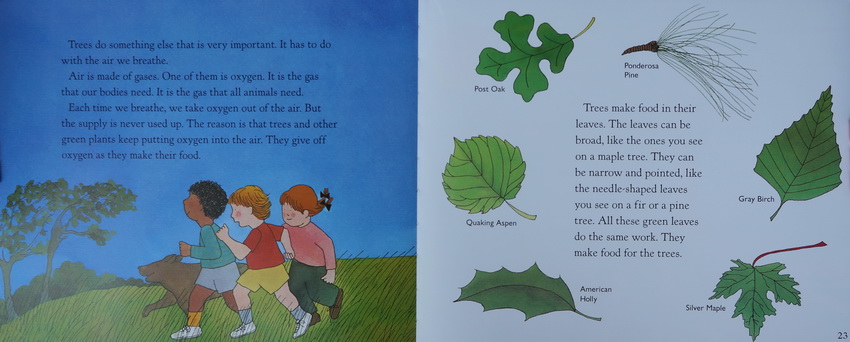
The opening of this book is a little misleading in itssimplicity- "Trees are nice. They're nice to look at, nice to havearound." Lauber goes on to explain increasingly complex topics,such as products made from trees (wood items, paper, maple syrup)and foods from them that animals and people rely on (fruit, nuts,chocolate, leaves, and flowers). They are described as homes for avariety of animals. Finally, an effective description ofphotosynthesis is provided. Readers will agree with the author'sconclusion that "...trees are more than nice-they're something wecan't live without!" The remaining three pages offer suggestionsfor young environmentalists, such as recycling and findingalternatives to paper products. The full-color labeledillustrations complement the text, as do the diagrams thatdemonstrate manufacturing and scientific processes. Multiethnicchildren appear throughout. A good introduction to the subject.
Trees are nice [and] also useful,'' begins the noted sciencewriter, summing up the concepts introduced here. Pointing out themany ordinary objects made from wood or, less obviously, treeproducts (rubber, turpentine, fruit, paper), she goes on to trees'role in animal habitats and the larger environment, includingphotosynthesis as an important part of a cycle on which we alldepend. The simple yet precise text ends with ways to ``Be a Friendto Trees''. Unfortunately, Keller's illustrations, while bright andattractive, are less precise; especially where tree species arelabeled, it's a shame to misrepresent them visually. Misshapenbirch trunks or vaguely depicted leaves are fine in the picturebook stories at which Keller excels, but they're inappropriate in ascience book, no matter how young the audience. Still, the lucidtext will make this useful; and creative teachers could make aproject of comparing real trees with the art.